Wednesday, 4 April 2012

The Big Lebowski


Reviewing a comedy is always difficult, since if you explain what makes it funny you're giving away the jokes and effectively spoiling the film. Reviewing something like The Big Lebowski is especially difficult, since it can be very hard to tell what it's actually about; the plot is wildly incoherent, and there are enough weird digressions and threads that go nowhere that summarising it is near impossible. This is, of course, the point, since it's a parody of detective stories in general and The Big Sleep in particular, and only serves to make the film even funnier.

Replacing the Philip Marlowe detective character with Jeff Bridges' lazy, slovenly Dude, constantly drinking White Russians, was a stroke of comic genius. This loveable stoner only wants to get back the rug that was stolen from him, but somehow ends up involved in a conspiracy that involves kidnapping, severed toes, being threatened with a ferret, and lots of bowling. The plot is nigh incomprehensible, but, this being a Coen brothers film, it's more about the characters than the plot at any rate. Remarkably, the Dude manages to be the only sane character in the film, having to deal with psychotic Vietnam veteran Walter (his best friend), omniscient Texan narrator the Stranger, and John Turturro in a bizarre cameo as blisteringly insane fellow bowler The Jesus. The characters are all well-drawn, even the ones who only show up for a scene or two, and are guaranteed to have you in stitches, The Jesus in particular, who is practically the definition of a one scene wonder.

The Dude is perhaps not Jeff Bridges' best role, although that is up for debate, but he is probably the definitive Jeff Bridges character all the same, and certainly his most iconic, having gone on to inform the characterisation of, among others, Crazy Heart's Bad Blake and True Grit's Rooster Cogburn. It's hard to shake the feeling that Bridges is essentially playing an exaggerated version of himself, not least because the Dude's actual name is Jeffrey; this sense of the actor's familiarity with the character's outlook on life is what makes how the Dude deals with his ridiculous situation plausible. Strangely, the fact that the Dude is almost completely divorced from how the real world works is what makes him the only one able to deal with the insane conspiracy reasonably, in contrast to Walter, who is constantly flying off the handle, threatening people and destroying their property. Part of what makes the situation they get caught in so entertaining is that it's almost entirely Walter's fault: if the Dude weren't friends with him, he likely would not have ended up so deep in the conspiracy.

Quite simply, this is one of those films that you simply have to see, especially if you're a fan of stoner comedy. The insane characters, nonsensical plot and incredibly surreal dream sequences add up to what is probably probably the Coen brothers' funniest film, and one of the funniest films you're likely to see.

Sunday, 18 March 2012

Speed Racer


Every once in a while, a film comes along that is so terrible that it makes you wonder, if people are able to make something this bad, was anything ever good to begin with? Speed Racer is one such film. An unmitigated catastrophe on pretty much every level, it has the dubious honour of being one of the only films to make me feel physically unwell.

As the above screenshot will hopefully illustrate, the film is a horrible, overdesigned mess whose constant stream of blinding colours will give you a migraine and make you thank whatever God you believe in for the tedious greyish brown of everyday life. There is nothing wrong with bright colours, but when they are in such abundance and the artistic design is so hideous that it genuinely hurts to look at it, there has definitely been a problem. It wouldn't be so bad if the effects weren't awful on a technical level as well, but the omnipresent CGI never fails to unimpress; it is abundantly clear that the set ends about 10 feet behind the actors and everything beyond that point is greenscreen, with potentially impressive cityscapes looking like the flat walls they were projected onto. It's a hideous film. Not in the Gears of War way where everything is drab and boring and indistinguishable from everything else, but in the way that it MAKES YOUR EYES BLEED.

Even if I hadn't been trying to watch the film through a blinding headache, I doubt it would have been any easier to follow. I have no idea what the plot was, since the script is as incoherent and nonsensical as the visuals. I knew I was in trouble when I found out that the main character's name actually was Speed Racer. That aside, there is a monkey (for some reason), who boxes with Speed's younger brother (for some reason). The sequence in question is so bizarre and hallucinatory that I thought I was either asleep, or someone had spiked my drink. I have no idea how it fitted into anything or what its purpose was. Other than that, there is Racer X, who Speed thinks is his brother, but then it's revealed that he isn't, but then it's revealed that he actually is and just had extensive plastic surgery so he is unrecognisable. WHYYYYY?!

There are those who think this film is fun. They are wrong. It's a mess, an impossible to follow catastrophe that makes you want to hit your head against a wall because it would be less painful than trying to watch this drivel. It's one of the worst films I've ever seen. And it's longer than Citizen Kane! It might have been tolerable at 70 minutes, but it instead blunders on for 130.

If you must watch Speed Racer, do so only with friends and a large bottle of industrial strength cider.

Wednesday, 15 February 2012

The Woman in Black - What Went Wrong


Let me preface this by saying that The Woman in Black, despite whatever justified reservations you may have about Daniel Radcliffe, is a very good film and you should definitely see it if you get the chance. Special mention has to go out to the set design: Eel Marsh House looks like Satis House after the apocalypse, and the whole film deserves some kind of special award for services to ludicrously creepy children's toys. It makes me happier than I can adequately say to see a horror film which knows that true horror has its roots in tension, suspense and mind games, not blood, gore and titties.

But.

I can't help but think there are, all the same, a lot of areas where it went wrong, and it's been a while since I wrote a negative review, so here goes. I'm going to try and keep spoilers to a minimum, but if it's on your To See list, I'd advise coming back and reading this afterwards.

First and foremost, while you will doubtless be on the edge of, and quite possibly hunched into, your seat for pretty much the entirety of the film, I can't shake the feeling that it just isn't scary enough. Part of this is probably due to knowing more or less what was going to happen, having read the book and seen the play; but that doesn't change the fact that the play is genuinely piss-your-pants terrifying while the film is merely quite scary.

The main part of the problem is a simple one: they show you the titular Woman far too much. She is at her scariest when you only just glimpse her, maybe for only a fraction of a second: the momentary flash of her face seen in a zoetrope, or when she's off to the side of the shot and out of focus. But the filmmakers insist on frequently putting her right in the middle of the frame, often for several seconds at a time, which does nothing but dilute the impact she has. There are a couple of moments towards the end when she runs straight at the camera screaming like a banshee, and yes, it's quite unnerving, but the fright is over as soon as she's off the screen again. In the play, you barely see her, but you feel her presence the whole time and are constantly frightened that she might appear. It's the first rule of horror filmmaking: the less you see of something, the more frightening it is. Our minds will always frighten us more effectively than a film can. This is doubly frustrating because I'm informed that they filmed it in extra-widescreen so they could experiment with putting things right on the edge of your field of view, but they don't take advantage of it nearly enough.

A corollary to this is probably more of a personal problem, I admit, but I wish they hadn't kept showing you the ghosts of the dead children. It's possibly because I love the play's ridiculously minimalist setup (a stage, two men, a box, and the Woman), but I felt like they detracted from the threat of the Woman herself. Every J-horror film made in the last decade has shown us that, yes, dead children are scary, and the trope feels overplayed and unnecessary. Like the Woman, we see far too much of them, and I can't help but feel like it was an just an opportunity to get what are essentially zombies into the film, as if we hadn't already seen enough of them in every book, film, game and comic produced in the last five years. They also cause serious problems with the ending, but I'll get to that in a minute.

*ENDING SPOILERS - DO NOT READ ON IF YOU WANT TO SEE THE FILM*

The ending, it has to be said, is crap. Utter trash. The ending of the play is incredibly depressing and results in you leaving the theatre absolutely terrified, where the ending here is an attempt to give some kind of redemption to Arthur Kipps. Quite apart from the syrupyness of it all, it doesn't make sense in the context of the story. In brief: the Woman makes his son walk in front of a train, Kipps runs to him, they both die. In itself, not bad. Would've been better if Kipps had survived a broken, hollow shell of a man, but still. But then, we see a sequence of Kipps and his son being reunited with his wife in what is presumably Heaven.

It doesn't work. Every indication so far has been that Heaven doesn't exist. The presence of the ghosts of the children killed by the Woman all but outright states that her victims are cursed to be restless for eternity and never find peace. Ciaran Hinds' character tells us the reason he doesn't believe in the Woman is because he wants to believe his son is in Heaven; she does exist, hence her victims cannot go to Heaven. Shortly before Kipps and his son are run over by the train, we hear the woman whisper "never forgive".

Apparently, her final revenge is to grant a tortured soul eternal peace with his beloved wife.

*END OF SPOILERS*

Let me conclude by reiterating my first point: The Woman in Black is a very good film. I'm still not entirely convinced about Daniel Radcliffe, but this was a step in the right direction for him; and Ciaran Hinds is as good in this as he ever is, even if I want to shout "Hail Caesar!" every time he appears on screen. All the same, it could so easily have been so much better. Here's hoping Hammer's next effort doesn't make the mistakes this one made.

Monday, 16 January 2012

The Artist


I have to admire the guts it took to make The Artist. It would be difficult enough to get away with making merely a black-and-white film these days, but The Artist is not only black-and-white: it's French, and it's silent. Getting international distribution for a silent film must have been a nightmare; it can't have been easy to convince the studio heads that foreign audiences would be interested in this film. But thank goodness it did get released over here, because it's a masterpiece.

The film is set during the late 1920s and early '30s, and is about George Valentin (played by Jean Dujardin), a silent film star, and Peppy Miller (Berenice Bejo), and up-and-coming actress. It covers the time period during which silent films fell out of fashion and talkies became successful; while Peppy rises to super-stardom in the talkies, Valentin falls out of favour because of his refusal to change. The plot is simple, yes, but that's no bad thing, and since The Artist is, in a sense, a throwback, a complicated plot would reduce the effect of the film. And just because it's simple doesn't mean it's predictable: the audience where I saw it applauded during the credits, and the happy ending will make you want to get up and cheer.

Much of the film's success is down to the two leads. Dujardin looks every inch the silent film star, all slicked-back hair and Errol Flynn pencil moustache, and is unfailingly charming and charismatic as Valentin, while Bejo radiates warmth and movie-star beauty, complete with a Marilyn Monroe-esque beauty spot. John Goodman, the film's biggest American star (although Malcolm McDowell does have a brief appearance) is very entertaining as the cigar-chomping boss of the studio where Valentin and Peppy work. It's actually really refreshing to watch a silent film: since the actors can't speak, they have to rely entirely on facial expression and body language to get their emotions across. This could result in mugging (which, in fact, is one of Peppy's criticisms of silent actors within the film), but here allows the actors to really show off their ability; Dujardin has already won Best Actor at Cannes, and he ought to at least be nominated for an Oscar. At no point in the film does the lack of dialogue make it difficult to follow what's happening: the actors' expressions tell the whole story without need of words. That said, where Dujardin and Bejo act out the story, it's Ludovic Bource's near omnipresent score which acts as the narrator. By turns whimsical, bombastic, and heartbreakingly sad, it perfectly conveys the mood of each scene and elevates great scenes to magnificent ones.

The film seems to be aware that, as a silent film in 2012, it's something of an oddity, and there's a pleasant amount of metacinematic humour at its own expense. There is one scene in particular which has a lot of fun with the fact that the film is silent, but the joke is too good to spoil here. The appealing thing about it is that the film reveres silent cinema without idolising it, and accepts that the time of the silent film had to end in favour of the talkies; during an argument between Dujardin and his wife, he remains sullen and refuses to talk, prompting her to ask, “Why do you refuse to talk?” Her criticism of his refusal to act in talkies is also an acceptance that cinema had to move on. The time period covered by the film continues into the early '30s, when talkies thoroughly dominated cinema, and instead of mourning the passing of the silent film, The Artist instead celebrates the newfound opportunities which sound offered to filmmakers. The sheer love of cinema itself on display here is absolutely wonderful, and is a strong contributor to what makes The Artist such a great film: when this much joy has gone into making something, it's hard to leave the cinema feeling anything else.

Akira Kurosawa, one of the greatest directors who ever lived, once said that silent films “are often so much more beautiful than sound pictures are. Perhaps they had to be”. As far as The Artist is concerned, he was absolutely right. This is one of the year's best films.

And it has the year's best dog in it, too.

Friday, 25 November 2011

In Defence of the Comic Book

In light of Frank Miller's amusingly insane ranting about the Occupy Wall Street movement, quite a lot of discussion about him has come up on the Interweb. I think this may have just been his attempt to get more publicity going for Holy Terror, but I digress. One of the various responses to his tirade was printed in the Guardian. For the most part, the article was decent enough and raised some good points: Frank Miller's insane rantings aren't exactly an uncommon point of view in America, and his comic 300 is indeed ninety pages of fascist drivel. One comment, however, stuck out to me, and pissed me right the fuck off.


"The comic books [is] made expressly to engage the attentions of pre- and just post-pubescent boys. Comic books are so politically dim-witted, so pie-in-the-sky idealistic as to be hard to take seriously". -- Rick Moody


What we have here is the gravely misinformed opinion of someone who has never read a comic book and thinks sequential art is only for kids. Now, I acknowledge that there may have been a time when comic books were written principally for children - the Silver Age in particular springs to mind - but, let's not forget, the Silver Age was thirty years ago. It staggers me that people still think of comics as juvenile; pretty much everybody saw The Dark Knight (and if you haven't, go and watch it now), and you cannot possibly argue that that film - which is, though some may disagree, an extraordinarily faithful adaptation of the comics - was made for children. 


The vast majority of the comics you can buy now are aimed at adults. I admit, I wish there were more comics aimed at kids, because it can be difficult to break into the medium, but that's a topic for another day. The publication of Watchmen and The Dark Knight Returns - both bleak, definitely not idealistic stories - in the '80s cemented comics as a medium for telling serious, adult stories, but somehow they still have the stigma of being picture books for children. While there's no shortage of bad writing in comics, and a lot of the "mainstream" stuff is still quite silly, the B-movie sci-fi schlockery of the '70s is long since dead. Comics grew up a lot in the '80s, and people need to realise that. Now, I'm not saying all comics aimed at adults are good, that would be crazy - 300, as mentioned in the article, is absolute trash - but people ought to at least give them a chance. Part of the problem is that, when people think about comics, they think about superheroes. While I think that's unfair, I can't argue too hard because it's the industry's own fault that they've pigeonholed themselves into that particular genre. That being said, there is no shortage of great comics which have nothing to do with superheroes, which most people don't seem to know exist.


To my mind, a large part of what made comics grow up is DC's Vertigo imprint, which has published, I think it's fair to say, most of the truly great comic series of the last twenty years. It's specifically aimed at adults; the focus is on what the creator wants, not the editor; and it's generally just damn good. Series like Hellblazer, Preacher, The Sandman and Transmetropolitan, all of which have won acclaim in the mainstream press, have been published by Vertigo, but people still seem to be largely unaware of them. None of these books are suitable for kids, but not in the stupid, posturing, macho, fascist way of 300. Yes, Preacher and Transmetropolitan can be quite wacky and silly at times, but they're nonetheless very mature books, and I'll be coming back to Transmet later. Hellblazer's main character is a chain-smoking Liverpudlian magician who is haunted by his accidental damning of a little girl to hell; it starts as it means to go on with the very first story ending with him killing one of his friends in order to banish a demon which is possessing him. Does that seem idealistic to you?


Now to address the point about comics being "politically dim-witted", to which I respond: do the bloody research. Tying in with and contributing to comics' growth in maturity during the '80s and '90s was the so-called "British Invasion": the breakthrough of many great British writers into the American comic book industry. Beginning with Alan Moore's Watchmen and his acclaimed run on Swamp Thing, helping show people that comics could be for adults, other writers like Grant Morrison (Animal Man, The Invisibles) and Jamie Delano (Hellblazer) were able to continue this trend. To my mind, the thing which characterises the British Invasion, apart from the maturity of the work, is its left-wing political stance. The entire plot of V for Vendetta is about the conflict between anarchism and fascism; Jamie Delano's run on Hellblazer satirised city bankers and the Conservative Party by giving Hell a stock market for souls and making the demons big fans of Mrs Thatcher. And I'm not even going to get into its views on religion, which could take up a post by themselves. If you ignore the political readings of these books you lose so much of them, and their impact is hugely diminished. 


But, when I think of political comics, the first thing that comes to mind is Warren Ellis' Transmetropolitan. It is the story of Spider Jerusalem (basically Hunter S. Thompson in disguise), a 25th-century gonzo journalist, and his battles with the Presidents who are trying to ruin America (one of whom is basically Richard Nixon in disguise). It is, without a doubt, one of the best and funniest pieces of political satire I have ever read in any medium. You could argue that Spider's views are not necessarily Ellis', but his polemics about the injustices of his society are just too powerful, and feel too genuine, for them not to be the author's opinion. And, let us not forget, "politics" derives from the Greek word for "city", and Transmet's setting is simply called The City. To describe this comic as politically dim-witted would be a bit like saying Apocalypse Now depicts the Vietnam War as being not that bad.


Every law that curbs my basic human freedoms; every lie about the things I care for; every crime committed against me by their politics; that's what makes me get up and hound these fuckers, and I'll do that until the day I die. -- Spider Jerusalem


I am of course not trying to argue that every comic out there is mature and politically smart; that would be as wrong as the quotation from which this post sprung. There is plenty of rubbish in the comic book medium, and a lot, indeed maybe the majority, of the stuff out there is not worth your time. But how is that different from any other medium? It is obvious that Rick Moody knows nothing about comics and is just spouting unfair disdain for them. Dismissing the entire medium because there are comics out there which are juvenile and politically stupid, as he has done, is a bit like saying that there are no novels worth your time and the entire medium is laughable because Twilight exists. There are plenty of smart, adult, simply great comic books out there that you should definitely read, but because of the prevailing opinion of the mainstream media that comics are for kids, they don't get the attention they deserve. 


Go and pick up a copy of Hellblazer or Transmetropolitan. You'll thank me for it.

Friday, 30 September 2011

On Minimalism

Disclaimer: this post principally concerns minimalism in videogames, but the points I make can apply equally well to other media.


I've been playing ICO lately, and it got me to thinking about, as the title of this post suggests, minimalism. Both of Team Ico's games to date, the aforementioned ICO as well as Shadow of the Colossus, are extremely minimalist in their design sensibilities, and, in my opinion, end up being much more successful than most other, bigger games, precisely because of the lack of clutter.

ICO was specifically designed as a minimalist game based around a "boy meets girl" concept; the player, controlling a boy called Ico, encounters a mysterious girl called Yorda early on, and your goal is simply to escape the fortress you're imprisoned in. There is nothing to the game that does not need to be there; pretty much everything in the game is necessary to reaching your goal. Puzzle elements that may seem entirely irrelevant and baffling early on become vital to completing later puzzles; there are exactly three named characters in the whole game, and the story is barely there compared to the huge epic RPGs of, say, BioWare or Square Enix. It's an extremely simple, elegant game, and this is where the appeal of minimalism as a whole, not just in videogames, presents itself; the creator can omit unnecessary details and make the whole experience feel cleaner and more straightforward. The lack of other stuff to clutter up the essentials means that the work can be more focused, and arguably means that it can tell its story or convey its message more effectively than it otherwise could.

As such, because of this simplicity, ICO ends up being far more emotionally hard-hitting than the biggest, grandest BioWare RPG, precisely because it's such a simple game. The story is, as I said, hardly there at all, but the environment positively drips with atmosphere and tells a lot about the world you're in purely by being there. Indeed, it's this atmosphere and the weird little half-story that make it more than just another puzzle game, largely because much of the story is told through gameplay rather than cutscenes. There are cutscenes, and they are heartbreakingly beautiful, but the emotional impact is there entirely because of the link built between Ico and Yorda. One cutscene in particular is as powerful as it is because it incorporates aspects of the gameplay, only with your and Yorda's roles reversed; to say more would be to spoil. Yorda is frail, frightened, incapable of defending herself, and utterly dependent on Ico for protection; she's curiously childlike, and because of this you can't help but care for her, not because you've been told to, but because of the way she acts. Pretty much her entire character is conveyed through gameplay, rather than the usual videogame way of gameplay-cutscene-gameplay-cutscene where the two aspects are entirely separate from each other. The Final Fantasy series is particularly guilty of this, in that all the player does is move the characters from one cutscene to another and contributes absolutely nothing to the story; in ICO, you feel like you're part of the world, because the game doesn't feel compelled to take control away from you every time the story moves forwards.

In this regard, I suppose, videogames have unique potential with regards to minimalist design, simply because their interactive nature means that they can tell the story while having the player take part, which, in theory at least, reduces the need to have the player kicked out and merely watch the story unfold. I say in theory because this potential has largely yet to be realised, but companies like Team Ico and Valve have proven very successful at keeping the player a part of the story. I'm not saying cutscenes should be abandoned altogether; story cannot always be told through gameplay, and they're definitely a useful tool for a designer. Likewise I'm not saying everything should use minimalist design, and I like epic RPGs as much as the next person.

But it would be nice if more designers cut out the fluff, the overly complicated stat-building and the vendor trash, in favour of focussing their design on what really matters.

Tuesday, 16 August 2011

What can change the nature of a man?


I realise I've not posted anything in a while, but I have good reason for that: I finally got round to playing Planescape: Torment, and it more or less took over my life for quite a while. As a huge fan of the Baldur's Gate series, I've long felt that I needed to play this game, and now that it's available on Good Old Games, I've been able to. And now I'm going to give you my thoughts on what, it has to be said, is one of the greatest RPGs ever made.

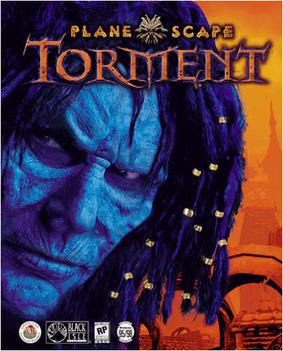
It's fair to say that it was a total commercial failure on its release. It's also fair to say that this was probably in large part due to its indescribably hideous box art, which, if it weren't for the North American box art of Ico, would probably qualify for the worst box art in history. And even then, it's a close thing. Doubtless part of its commercial failure is due to its weirdness and relative inaccessibility compared to other games of the time. There's little combat, and what little there is mostly isn't very good, and there's absolutely masses of very dense text, which would put a lot of people off the game. Compared to something like Baldur's Gate II, released a year later, it's quite difficult to get into. But the fact remains that the weirdness of its setting, its subverting of traditional RPG tropes, and its heavy emphasis on dialogue and story are what set it apart from other games of the time, and are what make it so memorable.

The first thing to understand is that the game is very strange. A lot of this is due to its use of the AD&D Planescape setting, which is far from your typical fantasy setting. This is one of the game's great strengths: it's that depressingly rare fantasy RPG that actually feels fantastic. It's not set in some muddy, Medieval, Tolkienesque kingdom, but in Sigil, a city that is essentially a crossroads for the entire multiverse. Walking down the street, you're more likely to meet a demon on leave from the eternal Blood War than an elf or a dwarf. Here, fiends and angels are a common fact of life, and succubi run brothels for the intellect. Pretty much anything can be a portal provided you have the right key, and these keys can be anything from an actual key, to making a certain gesture, to remembering what your first kiss was like. Streets can give birth, and belief is a force powerful enough to reshape the multiverse: if enough people believe in something, it can spontaneously come into being.

The story doesn't disappoint for weirdness either, but fully lives up to the potential provided by the setting. The game does all it can to avoid RPG cliches: instead of swords (of which there are only a couple in the whole game), you have equippable tattoos and earrings; instead of a party of heroic adventurers, you can recruit a floating skull whose main ability is insulting people (the first NPC you meet), a Scottish half-demon, a chaste succubus (who is also an agnostic priest), and a walking suit of armour animated by Justice; instead of saving the world, your goal is to solve the puzzle of the nature of the protagonist. Your journey will take you from the city of Sigil across the multiverse, to prisons which occupy entire Planes of existence, to Hell itself and back again. But now, back to the protagonist, for it is he that is the most remarkable and interesting thing about this game. And that's saying a lot.


The main character is the Nameless One, an amnesiac, horribly scarred immortal who has lived countless lives, and your goal is to learn who he is. It quickly becomes apparent that many of the people you meet know who you are, or rather, have known previous incarnations of you. They are not always pleased to see you. The Nameless One is a man who has lived countless lives and died countless deaths, but who always gets back up afterwards; this can be used to your advantage, and there are a few sections of the game where you need to die to proceed. This immortality doesn't make the game easier, but is basically identical in function to a quickload; it is essentially an investigation into the nature of death in RPGs. In most RPGs, when you die, you simply reload; in Torment, it's built into the game mechanics. The cheapness of death in RPGs is a core mechanic here, as well as a theme that is investigated in detail, and ultimately brutally deconstructed; the nature of the Nameless One's immortality is one of the big questions that drives the story. It's a rare game indeed that allows you to engage in philosophical debate on the nature of death, and it's an even rarer one that spends most of its story examining complex themes about life, death, and immortality. It's fair to say, I think, that the Nameless One is one of the most unique and fascinating characters in all fiction, and that's not something I say lightly.

There are flaws in the game, certainly; the sheer amount of text can be overwhelming, and the lack of combat relative to other games, as well as the fact that much of the combat is pretty dull, could definitely prevent people from getting into the game; and without fan-made patches and fixes, you're likely to run into quite a few bugs. But none of that should prevent you from playing Torment. If nothing else, play if for the uniqueness of the setting and characters; it's fair to say that there's no other RPG, before or since, that's quite like it. Yes, the graphics are dated, but the art design still looks great 12 years on, even if the colour palette is a little on the muddy side. And yes, you have to wade through enormous amounts of dialogue, but the dialogue is one of the game's best aspects. I could go on, but there's so much to talk about that I could be here all day. You can get this absolute gem of a game for less than $10 from Good Old Games, so if you like RPGs there's absolutely no reason not to play it. Read the dialogue, engage with the characters, learn about the Nameless One, and join the debate:

What can change the nature of a man?

Thursday, 7 July 2011

Hobbit photos

The first photos from the set of The Hobbit have been trickling onto the web, so I thought I'd share my opinions of them for those few who care. Predictably enough, from what little they've revealed so far, it's looking good.


First up, Martin Freeman as Bilbo. Costume design is nicely in keeping with the stuff Bilbo wore in the LotR films, but different enough that it's believable that a (comparatively) young character would wear it. Hell, Freeman even looks like a young Ian Holm. Very good choice for the character; so far, Bilbo's looking good.


The dwarves... I'm more hesitant about. They still look good, and it's nice that they appear to have decided to make each dwarf look very distinct; given how many of them there are, this will definitely be handy when it comes to keeping track of who's who. Now, I know The Hobbit is considerably more light-hearted than LotR, but I worry somewhat that the designs are a little, well, silly. Still, this is mostly just nit-picking. I'm still stupidly excited for this film.

Ok, fine. The dwarf on the left has hair that wouldn't look out of place in a Final Fantasy game. But other than that it looks good.

All pictures come from Empire Online.

Monday, 27 June 2011

Rotten Tomatoes: a monument to all your sins

I thought I'd do something different from my usual with this post. Rather than a review or a news post, I've decided to explain what I think about review aggregation site Rotten Tomatoes. You all know what it is, and almost certainly use it. I use it quite often, since it's a really helpful archive of reviews and makes finding an individual critic's opinion on a film much easier than it might be otherwise.

And I don't like it.

I'm well aware of how convenient it is to have all the reviews in one place, but on balance, I think Rotten Tomatoes is detrimental to the industry and unhelpful to consumers. You will have noticed that, in my reviews, I do not assign scores. This is because I don't believe a complicated opinion about a film can be adequately expressed by an arbitrary numerical value. I might think a film a failure, and yet interesting enough to watch anyway, like Sucker Punch (but more on that later); or I might think a film technically superb, but so dull that that I can't in good conscience recommend it, like Citizen Kane (on a narrative level: plodding, pretentious, glacially paced even for the time, and tremendously hypocritical on Orson Welles' part. On a technical level, however, one of the most important films ever made). How am I to rate these films? I can't. Not accurately, anyway. Now, I have no problem with other critics assigning scores, because if you don't have time to read the whole review it can be helpful to be able to quickly see their opinion. The problem with Rotten Tomatoes is that it aggregates these scores and gives you a percentage of critics who enjoyed the film. This is a serious problem, as most people view the Tomatometer as a simple indicator of how good a film is; the higher the percentage, the better the film.


Lex says it better than I ever could. At a glance, you can tell that this idea is critically flawed. The recent Star Trek reboot has a 94% rating on Rotten Tomatoes, which most people would take to mean that the film is excellent. It's not. It's certainly not bad, but it's nothing more or less than a competent space opera. There's nothing remarkable at all about it, no ambition, no commentary on the human condition which used to be Star Trek's hallmark. District 9 has a 91% rating; according to the Tomatometer, Star Trek is better than District 9. Again, refer to the picture above. District 9 is better directed, has better action, more interesting characters, and there's a purpose to the whole thing sorely lacking from Star Trek.

Let's now look at Sucker Punch in reference to Star Trek. I honestly don't know if I enjoyed this film or not. It's certainly not lacking for flaws: the plot is nearly incomprehensible at times, the characters are two-dimensional at best, and while the fight sequences are very, very good, the amount of slow-motion used is just ridiculous. And yet, in spite of all this, I can't convince myself it's a bad film. There's creativity here, ambition, the desire to be great, sorely lacking from Star Trek, and as a result, while it might be a technically inferior film, I would much rather watch Sucker Punch again, simply because it's interesting. To me, an ambitious film that doesn't quite come together is far preferable to one that sets low standards for itself and succeeds according to those standards. Sucker Punch has a 22% rating on the Tomatometer, and as a result, most people are going to pass it by, when, flaws or no, it really ought to be seen.

And whom do I blame for the unhelpfulness of the aggregate score? The consumer. The person who isn't interested in finding out why a film is good, but simply wants a binary yes/no answer to the question of whether or not they should go and see it. It is because of this that film criticism, as journalism in its own right, is dying. Film criticism is not mere consumer advice, but should be an interesting read on its own merits, picking apart the film and revealing things that you might have missed otherwise. It can be entertaining as a piece of writing, rather than just useful advice; go and read some of Roger Ebert's reviews of bad films. Many of them are hilarious, and considerably more entertaining than the film itself. People however, by and large, read film reviews as they would read a review for a vacuum cleaner: they simply want to know if it works or not. Rotten Tomatoes provides this. People assume that, if it has a high rating, it must be good, but as I hope to have demonstrated, this isn't necessarily true. Nor does it take into account films which might be guilty pleasures, such as G.I. Joe: by any reasonable standard, an awful film, but it's fun enough that it doesn't really matter.

So, I urge you, do not use the Tomatometer alone to judge if a film is good. Instead, go into the review archive, the thing Rotten Tomatoes does right, and read some actual reviews. Find a critic or two whose opinions you trust and agree with, and, when you're trying to decide whether to go and see a film, see what that critic thinks, not what the Tomatometer says.

Wednesday, 22 June 2011

13 Assassins

It's been a while, and I apologise for that, but I've had exams to deal with. Now, however, I'm free, and so shall hopefully be posting more often. In any case, this is exactly the kind of film I started this blog for: an obscure foreign film which not many will have heard of, but should absolutely see if they get a chance.

First off, this film, as might be expected from the fact that Takashi Miike directed it, isn't for the faint of heart. It's definitely earned its 18 rating, with an extremely violent and bloody final battle, as well as a prominently displayed quadruple amputee early in the film. If this sort of stuff doesn't bother you, and if, indeed, you enjoy tremendously violent battle sequences, you're in for a real treat here. The plot is very straightforward and fairly unremarkable, in all honesty. If you've seen any other men-on-a-mission film, you know what's going to happen here. The shogun's brother, Naritsugu, is a sadistic, psychopathic despot, and so one of his enemies hires a samurai to kill him. Said samurai recruits twelve other men, and they try to figure out how they're going to get their man.

Thirteen main characters is, it must be said, too many for a two-hour film. Only three or four of them get any real development, and you'll probably be hard pressed to even remember the names of most of them, let alone feel any particular sadness when they die. And no, that's not a spoiler, it's made clear very early in the film that this mission will probably lead to their deaths. Hell, the leader, Shinzaemon, wants to die on this mission, and earn an honourable death on the battlefield. There may be too many characters, but the actors playing them are generally very good. The thirteenth assassin, Koyata, reminds me a lot of Kikuchiyo from Seven Samurai, something I suspect may have been intentional, given how similar the plot of this film is to it.

Now that we've got that out of the way, we can discuss what most people are probably going to see this film for, and what will definitely be the most remembered aspect of it: the final battle. The assassins' plan to kill Naritsugu involves taking over a village and turning it into a deathtrap for his personal bodyguard. When Naritsugu arrives and the final confrontation begins, if you check your watch, you'll notice there's still about 45 minutes left of the film. The final battle lasts those 45 minutes. It possibly goes on a bit too long, but to be honest, I simply didn't care. This is one of the best battles I've seen in a film in quite some time. The various traps the assassins rig around the village keep the battle nice and varied, and some of the stuff that happens is so utterly mad that it would be a disservice to discuss it here; you need to see it for yourself. It's a completely deranged last 45 minutes, but it's so spectacular that it doesn't matter. A particular highlight is Hirayama, a ronin, taking on about 20 of Naritsugu's men all by himself.

Hollywood action film directors (Michael Bay in particular) would do well to watch this film and learn how you ought to film a battle sequence. It's as chaotic a battle as you're ever likely to see, but it's never difficult to tell what's happening, which is more than can be said for films which think extreme close-ups and shakycam are more important than a coherent scene. The shots are composed, and the camera is focused on people, such that it's never difficult to tell who is on which side; generally, the assassins are right in the centre of the shot, with the bodyguard surrounding them. Miike keeps the camera close enough to maintain the sense of chaos and being in the battle, but keeps it pulled back far enough that you can always see the action. As Batman Begins showed us, it doesn't matter how well-choreographed your fight scene is if the camera is so close to it that you can't see what's happening; this is never a problem for 13 Assassins; the battle is chaotic, absolutely, but it's never unclear what's happening.

If you like Japanese cinema and chambara films in particular, you owe it to yourself to see this film if you get a chance. The plot is pretty unremarkable, but the final battle sequence is one of the best I've seen in a long time. If you like action films at all, this is a must-see.

NB: there were supposed to be pictures, but Blogger's being irritating and won't attach them.