"We read fantasy to find the colours again, I think. To taste strong spices and hear the songs the sirens sang." -- GRRM
Wednesday, 13 June 2012
Solomon Kane
Monday, 21 May 2012
Watchmen
Tuesday, 10 April 2012
Highlander

In a lot of ways, it's exactly what you'd want from a sword-and-sorcery flick. It has entertaining ideas and a big scope, even if the budget is never quite up to the task. The premise is that there are Immortals among us, who can only die from being beheaded, and they are destined to fight until only one is left, whereupon he will claim the Prize. The hero is Connor MacLeod (Christopher Lambert), a 16th Century highlander, who believes himself to be an ordinary man until he is fatally wounded by the villainous Kurgan (Clancy Brown), but refuses to die. He meets another Immortal called Ramirez (Sean Connery), and is taught the ways of their kind and the rules of their Game. 400 years later, in New York, the few remaining Immortals convene for the Gathering, to fight to the last: there can be only one.
A lot of what makes the premise work is that the film never wastes time explaining it. How do the Immortals know what their task is? Why do the rules of the Game prevent them from fighting on holy ground? How do they know that the last one will claim the Prize? In avoiding explanations, the film never gets bogged down by minutiae, and the mystery over who the Immortals are lends a greater sense of the fantastic and the epic to the film. All the same, it's a very daft film, and probably ought not to work as well as it does. The cinematography is very nice, with the Scottish highlands lending themselves well to the task, but the special effects are a very mixed bag, with wires being clearly visible in many of the fight sequences. This is a particular shame because the fights are actually very impressive, with the duel between the Kurgan and Ramirez featuring possibly the best decapitation ever committed to film. And it would be remiss of me to not mention the thundering soundtrack by Queen, which is just as good as their soundtrack for Flash Gordon and without which the film would not be nearly as enjoyable.
Ropey effects aside, the film's biggest problem is its lead. Christopher Lambert looks the part, but it was on the basis of his looks that he was hired: when he arrived on set, having not met any of the crew before, director Russell Mulcahy discovered that he couldn't speak English, and so he had to learn during filming. This is the source of the bizarre train wreck of what I can only assume is supposed to be a Scottish accent, made even more jarring by having the very Scottish Sean Connery as his mentor. He is also partially blind, which means that his swordfighting is sadly never as good as it could have been. It's a real shame, because Connery and Clancy Brown, despite the latter's voracious devouring of scenery, are very good in their roles, and Lambert seems very subdued and uninteresting compared to them.
All these flaws aside, I do recommend Highlander. It's still one of the better fantasy films that don't star Frodo or Westley, and would probably be remembered as fondly as Conan if the effects had been better and it hadn't been blighted by a string of terrible sequels. Lambert is still a better actor than Arnold, though.
Wednesday, 4 April 2012
The Big Lebowski
Sunday, 18 March 2012
Speed Racer
Every once in a while, a film comes along that is so terrible that it makes you wonder, if people are able to make something this bad, was anything ever good to begin with? Speed Racer is one such film. An unmitigated catastrophe on pretty much every level, it has the dubious honour of being one of the only films to make me feel physically unwell.
As the above screenshot will hopefully illustrate, the film is a horrible, overdesigned mess whose constant stream of blinding colours will give you a migraine and make you thank whatever God you believe in for the tedious greyish brown of everyday life. There is nothing wrong with bright colours, but when they are in such abundance and the artistic design is so hideous that it genuinely hurts to look at it, there has definitely been a problem. It wouldn't be so bad if the effects weren't awful on a technical level as well, but the omnipresent CGI never fails to unimpress; it is abundantly clear that the set ends about 10 feet behind the actors and everything beyond that point is greenscreen, with potentially impressive cityscapes looking like the flat walls they were projected onto. It's a hideous film. Not in the Gears of War way where everything is drab and boring and indistinguishable from everything else, but in the way that it MAKES YOUR EYES BLEED.
Even if I hadn't been trying to watch the film through a blinding headache, I doubt it would have been any easier to follow. I have no idea what the plot was, since the script is as incoherent and nonsensical as the visuals. I knew I was in trouble when I found out that the main character's name actually was Speed Racer. That aside, there is a monkey (for some reason), who boxes with Speed's younger brother (for some reason). The sequence in question is so bizarre and hallucinatory that I thought I was either asleep, or someone had spiked my drink. I have no idea how it fitted into anything or what its purpose was. Other than that, there is Racer X, who Speed thinks is his brother, but then it's revealed that he isn't, but then it's revealed that he actually is and just had extensive plastic surgery so he is unrecognisable. WHYYYYY?!
There are those who think this film is fun. They are wrong. It's a mess, an impossible to follow catastrophe that makes you want to hit your head against a wall because it would be less painful than trying to watch this drivel. It's one of the worst films I've ever seen. And it's longer than Citizen Kane! It might have been tolerable at 70 minutes, but it instead blunders on for 130.
If you must watch Speed Racer, do so only with friends and a large bottle of industrial strength cider.
Wednesday, 15 February 2012
The Woman in Black - What Went Wrong
Let me preface this by saying that The Woman in Black, despite whatever justified reservations you may have about Daniel Radcliffe, is a very good film and you should definitely see it if you get the chance. Special mention has to go out to the set design: Eel Marsh House looks like Satis House after the apocalypse, and the whole film deserves some kind of special award for services to ludicrously creepy children's toys. It makes me happier than I can adequately say to see a horror film which knows that true horror has its roots in tension, suspense and mind games, not blood, gore and titties.
But.
I can't help but think there are, all the same, a lot of areas where it went wrong, and it's been a while since I wrote a negative review, so here goes. I'm going to try and keep spoilers to a minimum, but if it's on your To See list, I'd advise coming back and reading this afterwards.
First and foremost, while you will doubtless be on the edge of, and quite possibly hunched into, your seat for pretty much the entirety of the film, I can't shake the feeling that it just isn't scary enough. Part of this is probably due to knowing more or less what was going to happen, having read the book and seen the play; but that doesn't change the fact that the play is genuinely piss-your-pants terrifying while the film is merely quite scary.
The main part of the problem is a simple one: they show you the titular Woman far too much. She is at her scariest when you only just glimpse her, maybe for only a fraction of a second: the momentary flash of her face seen in a zoetrope, or when she's off to the side of the shot and out of focus. But the filmmakers insist on frequently putting her right in the middle of the frame, often for several seconds at a time, which does nothing but dilute the impact she has. There are a couple of moments towards the end when she runs straight at the camera screaming like a banshee, and yes, it's quite unnerving, but the fright is over as soon as she's off the screen again. In the play, you barely see her, but you feel her presence the whole time and are constantly frightened that she might appear. It's the first rule of horror filmmaking: the less you see of something, the more frightening it is. Our minds will always frighten us more effectively than a film can. This is doubly frustrating because I'm informed that they filmed it in extra-widescreen so they could experiment with putting things right on the edge of your field of view, but they don't take advantage of it nearly enough.
A corollary to this is probably more of a personal problem, I admit, but I wish they hadn't kept showing you the ghosts of the dead children. It's possibly because I love the play's ridiculously minimalist setup (a stage, two men, a box, and the Woman), but I felt like they detracted from the threat of the Woman herself. Every J-horror film made in the last decade has shown us that, yes, dead children are scary, and the trope feels overplayed and unnecessary. Like the Woman, we see far too much of them, and I can't help but feel like it was an just an opportunity to get what are essentially zombies into the film, as if we hadn't already seen enough of them in every book, film, game and comic produced in the last five years. They also cause serious problems with the ending, but I'll get to that in a minute.
*ENDING SPOILERS - DO NOT READ ON IF YOU WANT TO SEE THE FILM*
The ending, it has to be said, is crap. Utter trash. The ending of the play is incredibly depressing and results in you leaving the theatre absolutely terrified, where the ending here is an attempt to give some kind of redemption to Arthur Kipps. Quite apart from the syrupyness of it all, it doesn't make sense in the context of the story. In brief: the Woman makes his son walk in front of a train, Kipps runs to him, they both die. In itself, not bad. Would've been better if Kipps had survived a broken, hollow shell of a man, but still. But then, we see a sequence of Kipps and his son being reunited with his wife in what is presumably Heaven.
It doesn't work. Every indication so far has been that Heaven doesn't exist. The presence of the ghosts of the children killed by the Woman all but outright states that her victims are cursed to be restless for eternity and never find peace. Ciaran Hinds' character tells us the reason he doesn't believe in the Woman is because he wants to believe his son is in Heaven; she does exist, hence her victims cannot go to Heaven. Shortly before Kipps and his son are run over by the train, we hear the woman whisper "never forgive".
Apparently, her final revenge is to grant a tortured soul eternal peace with his beloved wife.
*END OF SPOILERS*
Let me conclude by reiterating my first point: The Woman in Black is a very good film. I'm still not entirely convinced about Daniel Radcliffe, but this was a step in the right direction for him; and Ciaran Hinds is as good in this as he ever is, even if I want to shout "Hail Caesar!" every time he appears on screen. All the same, it could so easily have been so much better. Here's hoping Hammer's next effort doesn't make the mistakes this one made.
Monday, 16 January 2012
The Artist
Friday, 25 November 2011
In Defence of the Comic Book
"The comic books [is] made expressly to engage the attentions of pre- and just post-pubescent boys. Comic books are so politically dim-witted, so pie-in-the-sky idealistic as to be hard to take seriously". -- Rick Moody
The vast majority of the comics you can buy now are aimed at adults. I admit, I wish there were more comics aimed at kids, because it can be difficult to break into the medium, but that's a topic for another day. The publication of Watchmen and The Dark Knight Returns - both bleak, definitely not idealistic stories - in the '80s cemented comics as a medium for telling serious, adult stories, but somehow they still have the stigma of being picture books for children. While there's no shortage of bad writing in comics, and a lot of the "mainstream" stuff is still quite silly, the B-movie sci-fi schlockery of the '70s is long since dead. Comics grew up a lot in the '80s, and people need to realise that. Now, I'm not saying all comics aimed at adults are good, that would be crazy - 300, as mentioned in the article, is absolute trash - but people ought to at least give them a chance. Part of the problem is that, when people think about comics, they think about superheroes. While I think that's unfair, I can't argue too hard because it's the industry's own fault that they've pigeonholed themselves into that particular genre. That being said, there is no shortage of great comics which have nothing to do with superheroes, which most people don't seem to know exist.
To my mind, a large part of what made comics grow up is DC's Vertigo imprint, which has published, I think it's fair to say, most of the truly great comic series of the last twenty years. It's specifically aimed at adults; the focus is on what the creator wants, not the editor; and it's generally just damn good. Series like Hellblazer, Preacher, The Sandman and Transmetropolitan, all of which have won acclaim in the mainstream press, have been published by Vertigo, but people still seem to be largely unaware of them. None of these books are suitable for kids, but not in the stupid, posturing, macho, fascist way of 300. Yes, Preacher and Transmetropolitan can be quite wacky and silly at times, but they're nonetheless very mature books, and I'll be coming back to Transmet later. Hellblazer's main character is a chain-smoking Liverpudlian magician who is haunted by his accidental damning of a little girl to hell; it starts as it means to go on with the very first story ending with him killing one of his friends in order to banish a demon which is possessing him. Does that seem idealistic to you?
Now to address the point about comics being "politically dim-witted", to which I respond: do the bloody research. Tying in with and contributing to comics' growth in maturity during the '80s and '90s was the so-called "British Invasion": the breakthrough of many great British writers into the American comic book industry. Beginning with Alan Moore's Watchmen and his acclaimed run on Swamp Thing, helping show people that comics could be for adults, other writers like Grant Morrison (Animal Man, The Invisibles) and Jamie Delano (Hellblazer) were able to continue this trend. To my mind, the thing which characterises the British Invasion, apart from the maturity of the work, is its left-wing political stance. The entire plot of V for Vendetta is about the conflict between anarchism and fascism; Jamie Delano's run on Hellblazer satirised city bankers and the Conservative Party by giving Hell a stock market for souls and making the demons big fans of Mrs Thatcher. And I'm not even going to get into its views on religion, which could take up a post by themselves. If you ignore the political readings of these books you lose so much of them, and their impact is hugely diminished.
But, when I think of political comics, the first thing that comes to mind is Warren Ellis' Transmetropolitan. It is the story of Spider Jerusalem (basically Hunter S. Thompson in disguise), a 25th-century gonzo journalist, and his battles with the Presidents who are trying to ruin America (one of whom is basically Richard Nixon in disguise). It is, without a doubt, one of the best and funniest pieces of political satire I have ever read in any medium. You could argue that Spider's views are not necessarily Ellis', but his polemics about the injustices of his society are just too powerful, and feel too genuine, for them not to be the author's opinion. And, let us not forget, "politics" derives from the Greek word for "city", and Transmet's setting is simply called The City. To describe this comic as politically dim-witted would be a bit like saying Apocalypse Now depicts the Vietnam War as being not that bad.
I am of course not trying to argue that every comic out there is mature and politically smart; that would be as wrong as the quotation from which this post sprung. There is plenty of rubbish in the comic book medium, and a lot, indeed maybe the majority, of the stuff out there is not worth your time. But how is that different from any other medium? It is obvious that Rick Moody knows nothing about comics and is just spouting unfair disdain for them. Dismissing the entire medium because there are comics out there which are juvenile and politically stupid, as he has done, is a bit like saying that there are no novels worth your time and the entire medium is laughable because Twilight exists. There are plenty of smart, adult, simply great comic books out there that you should definitely read, but because of the prevailing opinion of the mainstream media that comics are for kids, they don't get the attention they deserve.
Go and pick up a copy of Hellblazer or Transmetropolitan. You'll thank me for it.
Friday, 30 September 2011
On Minimalism
I've been playing ICO lately, and it got me to thinking about, as the title of this post suggests, minimalism. Both of Team Ico's games to date, the aforementioned ICO as well as Shadow of the Colossus, are extremely minimalist in their design sensibilities, and, in my opinion, end up being much more successful than most other, bigger games, precisely because of the lack of clutter.
ICO was specifically designed as a minimalist game based around a "boy meets girl" concept; the player, controlling a boy called Ico, encounters a mysterious girl called Yorda early on, and your goal is simply to escape the fortress you're imprisoned in. There is nothing to the game that does not need to be there; pretty much everything in the game is necessary to reaching your goal. Puzzle elements that may seem entirely irrelevant and baffling early on become vital to completing later puzzles; there are exactly three named characters in the whole game, and the story is barely there compared to the huge epic RPGs of, say, BioWare or Square Enix. It's an extremely simple, elegant game, and this is where the appeal of minimalism as a whole, not just in videogames, presents itself; the creator can omit unnecessary details and make the whole experience feel cleaner and more straightforward. The lack of other stuff to clutter up the essentials means that the work can be more focused, and arguably means that it can tell its story or convey its message more effectively than it otherwise could.
As such, because of this simplicity, ICO ends up being far more emotionally hard-hitting than the biggest, grandest BioWare RPG, precisely because it's such a simple game. The story is, as I said, hardly there at all, but the environment positively drips with atmosphere and tells a lot about the world you're in purely by being there. Indeed, it's this atmosphere and the weird little half-story that make it more than just another puzzle game, largely because much of the story is told through gameplay rather than cutscenes. There are cutscenes, and they are heartbreakingly beautiful, but the emotional impact is there entirely because of the link built between Ico and Yorda. One cutscene in particular is as powerful as it is because it incorporates aspects of the gameplay, only with your and Yorda's roles reversed; to say more would be to spoil. Yorda is frail, frightened, incapable of defending herself, and utterly dependent on Ico for protection; she's curiously childlike, and because of this you can't help but care for her, not because you've been told to, but because of the way she acts. Pretty much her entire character is conveyed through gameplay, rather than the usual videogame way of gameplay-cutscene-gameplay-cutscene where the two aspects are entirely separate from each other. The Final Fantasy series is particularly guilty of this, in that all the player does is move the characters from one cutscene to another and contributes absolutely nothing to the story; in ICO, you feel like you're part of the world, because the game doesn't feel compelled to take control away from you every time the story moves forwards.
In this regard, I suppose, videogames have unique potential with regards to minimalist design, simply because their interactive nature means that they can tell the story while having the player take part, which, in theory at least, reduces the need to have the player kicked out and merely watch the story unfold. I say in theory because this potential has largely yet to be realised, but companies like Team Ico and Valve have proven very successful at keeping the player a part of the story. I'm not saying cutscenes should be abandoned altogether; story cannot always be told through gameplay, and they're definitely a useful tool for a designer. Likewise I'm not saying everything should use minimalist design, and I like epic RPGs as much as the next person.
But it would be nice if more designers cut out the fluff, the overly complicated stat-building and the vendor trash, in favour of focussing their design on what really matters.
Tuesday, 16 August 2011
What can change the nature of a man?

I realise I've not posted anything in a while, but I have good reason for that: I finally got round to playing Planescape: Torment, and it more or less took over my life for quite a while. As a huge fan of the Baldur's Gate series, I've long felt that I needed to play this game, and now that it's available on Good Old Games, I've been able to. And now I'm going to give you my thoughts on what, it has to be said, is one of the greatest RPGs ever made.
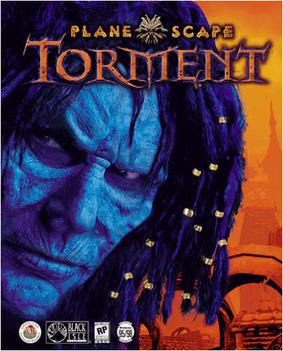
It's fair to say that it was a total commercial failure on its release. It's also fair to say that this was probably in large part due to its indescribably hideous box art, which, if it weren't for the North American box art of Ico, would probably qualify for the worst box art in history. And even then, it's a close thing. Doubtless part of its commercial failure is due to its weirdness and relative inaccessibility compared to other games of the time. There's little combat, and what little there is mostly isn't very good, and there's absolutely masses of very dense text, which would put a lot of people off the game. Compared to something like Baldur's Gate II, released a year later, it's quite difficult to get into. But the fact remains that the weirdness of its setting, its subverting of traditional RPG tropes, and its heavy emphasis on dialogue and story are what set it apart from other games of the time, and are what make it so memorable.
The first thing to understand is that the game is very strange. A lot of this is due to its use of the AD&D Planescape setting, which is far from your typical fantasy setting. This is one of the game's great strengths: it's that depressingly rare fantasy RPG that actually feels fantastic. It's not set in some muddy, Medieval, Tolkienesque kingdom, but in Sigil, a city that is essentially a crossroads for the entire multiverse. Walking down the street, you're more likely to meet a demon on leave from the eternal Blood War than an elf or a dwarf. Here, fiends and angels are a common fact of life, and succubi run brothels for the intellect. Pretty much anything can be a portal provided you have the right key, and these keys can be anything from an actual key, to making a certain gesture, to remembering what your first kiss was like. Streets can give birth, and belief is a force powerful enough to reshape the multiverse: if enough people believe in something, it can spontaneously come into being.
The story doesn't disappoint for weirdness either, but fully lives up to the potential provided by the setting. The game does all it can to avoid RPG cliches: instead of swords (of which there are only a couple in the whole game), you have equippable tattoos and earrings; instead of a party of heroic adventurers, you can recruit a floating skull whose main ability is insulting people (the first NPC you meet), a Scottish half-demon, a chaste succubus (who is also an agnostic priest), and a walking suit of armour animated by Justice; instead of saving the world, your goal is to solve the puzzle of the nature of the protagonist. Your journey will take you from the city of Sigil across the multiverse, to prisons which occupy entire Planes of existence, to Hell itself and back again. But now, back to the protagonist, for it is he that is the most remarkable and interesting thing about this game. And that's saying a lot.
The main character is the Nameless One, an amnesiac, horribly scarred immortal who has lived countless lives, and your goal is to learn who he is. It quickly becomes apparent that many of the people you meet know who you are, or rather, have known previous incarnations of you. They are not always pleased to see you. The Nameless One is a man who has lived countless lives and died countless deaths, but who always gets back up afterwards; this can be used to your advantage, and there are a few sections of the game where you need to die to proceed. This immortality doesn't make the game easier, but is basically identical in function to a quickload; it is essentially an investigation into the nature of death in RPGs. In most RPGs, when you die, you simply reload; in Torment, it's built into the game mechanics. The cheapness of death in RPGs is a core mechanic here, as well as a theme that is investigated in detail, and ultimately brutally deconstructed; the nature of the Nameless One's immortality is one of the big questions that drives the story. It's a rare game indeed that allows you to engage in philosophical debate on the nature of death, and it's an even rarer one that spends most of its story examining complex themes about life, death, and immortality. It's fair to say, I think, that the Nameless One is one of the most unique and fascinating characters in all fiction, and that's not something I say lightly.
There are flaws in the game, certainly; the sheer amount of text can be overwhelming, and the lack of combat relative to other games, as well as the fact that much of the combat is pretty dull, could definitely prevent people from getting into the game; and without fan-made patches and fixes, you're likely to run into quite a few bugs. But none of that should prevent you from playing Torment. If nothing else, play if for the uniqueness of the setting and characters; it's fair to say that there's no other RPG, before or since, that's quite like it. Yes, the graphics are dated, but the art design still looks great 12 years on, even if the colour palette is a little on the muddy side. And yes, you have to wade through enormous amounts of dialogue, but the dialogue is one of the game's best aspects. I could go on, but there's so much to talk about that I could be here all day. You can get this absolute gem of a game for less than $10 from Good Old Games, so if you like RPGs there's absolutely no reason not to play it. Read the dialogue, engage with the characters, learn about the Nameless One, and join the debate:
What can change the nature of a man?